

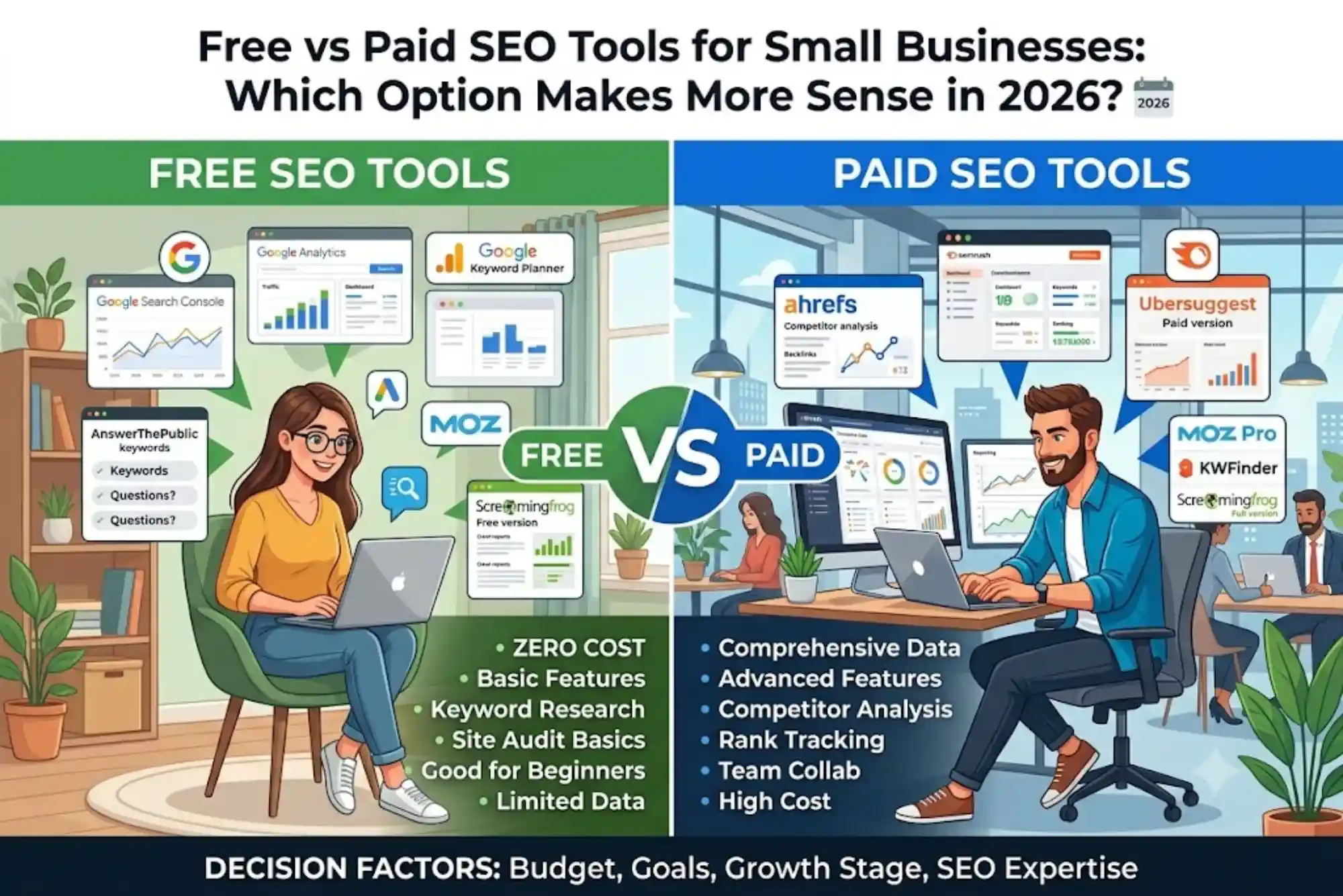
Small businesses in 2026 have access to more SEO tools than ever before. Free platforms provide valuable insights for startups and local companies with limited budgets, while paid solutions offer deeper analytics, competitive intelligence, automation, and scalability. The right choice depends on business goals, growth stage, competition level, and available marketing resources.
Search engine optimization remains one of the most cost-effective ways to attract customers online. While paid advertising stops generating traffic when budgets run out, organic visibility can continue producing leads for months or even years. As businesses increasingly rely on digital channels, selecting the right SEO toolkit has become an important strategic decision.
Why SEO Tools Matter More Than Ever in 2026
The search landscape continues to evolve. AI-powered search experiences, changing user behavior, mobile-first indexing, and increasing competition have made SEO more data-driven than ever. Businesses can no longer rely on guesswork to improve rankings.
SEO tools help companies:
- Discover valuable keywords
- Track search rankings
- Analyze competitors
- Identify technical website issues
- Monitor backlinks
- Measure organic traffic performance
- Optimize content strategies
Businesses that understand search behavior often gain a competitive advantage. This is particularly important as technology continues transforming industries and customer acquisition channels.
What Are Free SEO Tools?
Free SEO tools provide access to basic optimization features without requiring a monthly subscription. They are often offered by search engines, software providers, browser extensions, or freemium platforms.

Common examples include:
- Google Search Console
- Google Analytics
- Google Keyword Planner
- Bing Webmaster Tools
- SEO browser extensions
- Basic site audit tools
These tools can deliver significant value, especially for businesses just beginning their SEO journey.
Advantages of Free SEO Tools
- No financial investment required
- Ideal for startups and small budgets
- Useful for learning SEO fundamentals
- Direct access to search performance data
- Easy implementation and setup
Limitations of Free SEO Tools
- Restricted keyword databases
- Limited competitor analysis
- Fewer reporting capabilities
- Reduced automation
- Data restrictions and usage caps
For businesses operating in highly competitive industries, these limitations can become significant obstacles as growth accelerates.
What Are Paid SEO Tools?
Paid SEO tools are subscription-based platforms designed to provide deeper insights, larger datasets, workflow automation, and advanced reporting capabilities.
Most professional SEO agencies and experienced marketers rely on paid software because it allows them to make more informed decisions faster.
Typical features include:
- Extensive keyword research databases
- Competitor intelligence
- Advanced backlink analysis
- Content optimization recommendations
- Technical SEO auditing
- Rank tracking across multiple locations
- Automated reporting dashboards
Businesses seeking sustainable growth often combine paid SEO software with broader digital marketing strategies. Similar strategic thinking is discussed in the role of SEO in digital marketing.
Free vs Paid SEO Tools: Side-by-Side Comparison
| Feature | Free SEO Tools | Paid SEO Tools |
|---|---|---|
| Cost | Free | Monthly or annual subscription |
| Keyword Research | Basic | Advanced and comprehensive |
| Competitor Analysis | Limited | Extensive |
| Backlink Monitoring | Basic | Detailed and scalable |
| Reporting | Manual | Automated |
| Site Audits | Limited | Comprehensive |
| Scalability | Low to moderate | High |
| Support | Minimal | Dedicated customer support |
When Free SEO Tools Make the Most Sense
Free SEO tools remain a practical option for many organizations. They are particularly effective during the early stages of business development.
Free tools may be sufficient when:
- Your website is new
- You target a small local audience
- Your marketing budget is limited
- You manage SEO personally
- You only need basic reporting
A local service business, for example, may successfully generate leads using Google Search Console, Google Analytics, and strong content creation practices.
Companies learning how to establish online visibility often begin with foundational optimization techniques similar to those outlined in organic SEO best practices.
When Paid SEO Tools Become Worth the Investment
As businesses grow, SEO challenges become more complex. Competition increases, content production expands, and reporting requirements become more demanding.
Paid tools generally become worthwhile when:
- You publish content regularly
- You operate in competitive markets
- You rely heavily on organic traffic
- You manage multiple websites
- You need competitor intelligence
- You require detailed reporting
The value of paid software often comes from efficiency. Tasks that might require hours using free tools can frequently be completed within minutes using advanced platforms.
The Real Cost Question: ROI vs Subscription Fees
Many small business owners focus solely on subscription costs when evaluating SEO software. However, the more important metric is return on investment.
A paid SEO platform may cost a monthly fee, but if it helps identify profitable keywords, uncover technical issues, or increase organic leads, the investment can pay for itself quickly.
Before choosing a tool, evaluate:
- Current website traffic
- Lead generation goals
- Customer acquisition costs
- Industry competition
- Internal marketing resources
Businesses undergoing a major operational shift often discover that investing in better technology creates long-term advantages, much like a paradigm shift in business can redefine growth opportunities.
Which SEO Functions Usually Require Paid Tools?
Not every SEO activity requires premium software. However, certain tasks become significantly easier with paid platforms.
Advanced Keyword Research
Premium tools typically offer larger keyword databases, search volume estimates, ranking difficulty metrics, and trend forecasting.
Competitive Intelligence
Understanding which keywords drive traffic to competitors can uncover valuable opportunities.
Backlink Analysis
Paid platforms generally maintain larger backlink indexes and more accurate authority metrics.
Content Gap Analysis
These features help identify topics competitors rank for that your website has not yet covered.
Technical SEO Monitoring
Large websites benefit from continuous monitoring for crawl errors, indexing issues, broken links, and performance problems.
Hybrid Approach: The Best Option for Many Small Businesses
In practice, many successful businesses use a combination of free and paid SEO tools.
A hybrid setup may include:
- Google Search Console for indexing insights
- Google Analytics for traffic measurement
- A paid keyword research platform
- A paid site audit tool
- Content optimization software
This approach balances affordability with access to advanced data.
For many growing companies, hybrid systems provide the strongest balance between cost control and performance improvement.
How to Choose the Right SEO Tool Strategy
Selecting the right solution starts with understanding business objectives.
- Define growth goals for the next 12 months.
- Assess current website traffic levels.
- Evaluate available marketing resources.
- Identify reporting requirements.
- Calculate potential SEO-driven revenue.
- Test free options before committing to subscriptions.
- Upgrade only when advanced functionality becomes necessary.
Independent reviews, software comparisons, and official documentation can help evaluate available solutions. [Insert relevant reference link here]
Common Mistakes Small Businesses Make
- Paying for expensive software before establishing an SEO strategy
- Ignoring free tools provided by search engines
- Focusing on features instead of business outcomes
- Purchasing multiple overlapping subscriptions
- Failing to analyze tool-generated data
- Expecting software alone to improve rankings
SEO success still depends on content quality, technical optimization, user experience, and strategic execution.
Frequently Asked Questions
Can free SEO tools improve rankings?
Yes. Free tools can identify technical issues, track performance, and support optimization efforts. Many small websites achieve strong rankings using primarily free resources.
Are paid SEO tools necessary for every business?
No. Businesses with limited competition or small websites may achieve their goals using free tools. Paid platforms become more valuable as complexity and competition increase.
How much should a small business spend on SEO tools?
There is no universal amount. The appropriate investment depends on business size, industry competition, growth objectives, and expected return on investment.
Can I combine free and paid SEO tools?
Yes. Many successful businesses use free tools for analytics and indexing data while relying on paid platforms for advanced keyword research and competitor analysis.
Conclusion
The debate around free vs paid SEO tools is not really about which category is better. It is about choosing the right level of functionality for your business stage and objectives. Free tools remain excellent for startups, local businesses, and organizations learning SEO fundamentals. Paid platforms become increasingly valuable when competition intensifies, reporting requirements grow, and organic search becomes a major revenue driver.
For most small businesses in 2026, the smartest approach is often a balanced combination of free and paid solutions. By investing only where advanced insights create measurable value, businesses can maximize SEO performance while maintaining budget efficiency.
Related Reading: Affordable SEO Tools for Small Businesses on a Practical Budget in 2026
Related Reading: What Are SEO Tools for Small Businesses and Which Features Matter Most in 2026?
Related Reading: HandiFox Services: The Best QuickBooks Inventory Management Solution for U.S. Small Businesses
Related Reading: Best All-in-One SEO Tools for Small Businesses in 2026: What to Use and Why