Search engine optimisation has moved from being a specialist discipline reserved for large marketing teams to something every small business owner is expected to have at least a working understanding of. The shift has been driven largely by the tools themselves — platforms that once required technical expertise to operate have become progressively more accessible, more automated, and more affordable. But with dozens of options in the market, understanding what SEO tools for small businesses actually do and which features genuinely move the needle is far from straightforward. This guide cuts through the noise and explains what these tools are, how they work, and what to prioritise when choosing one for a small business in 2026.
What Are SEO Tools for Small Businesses?
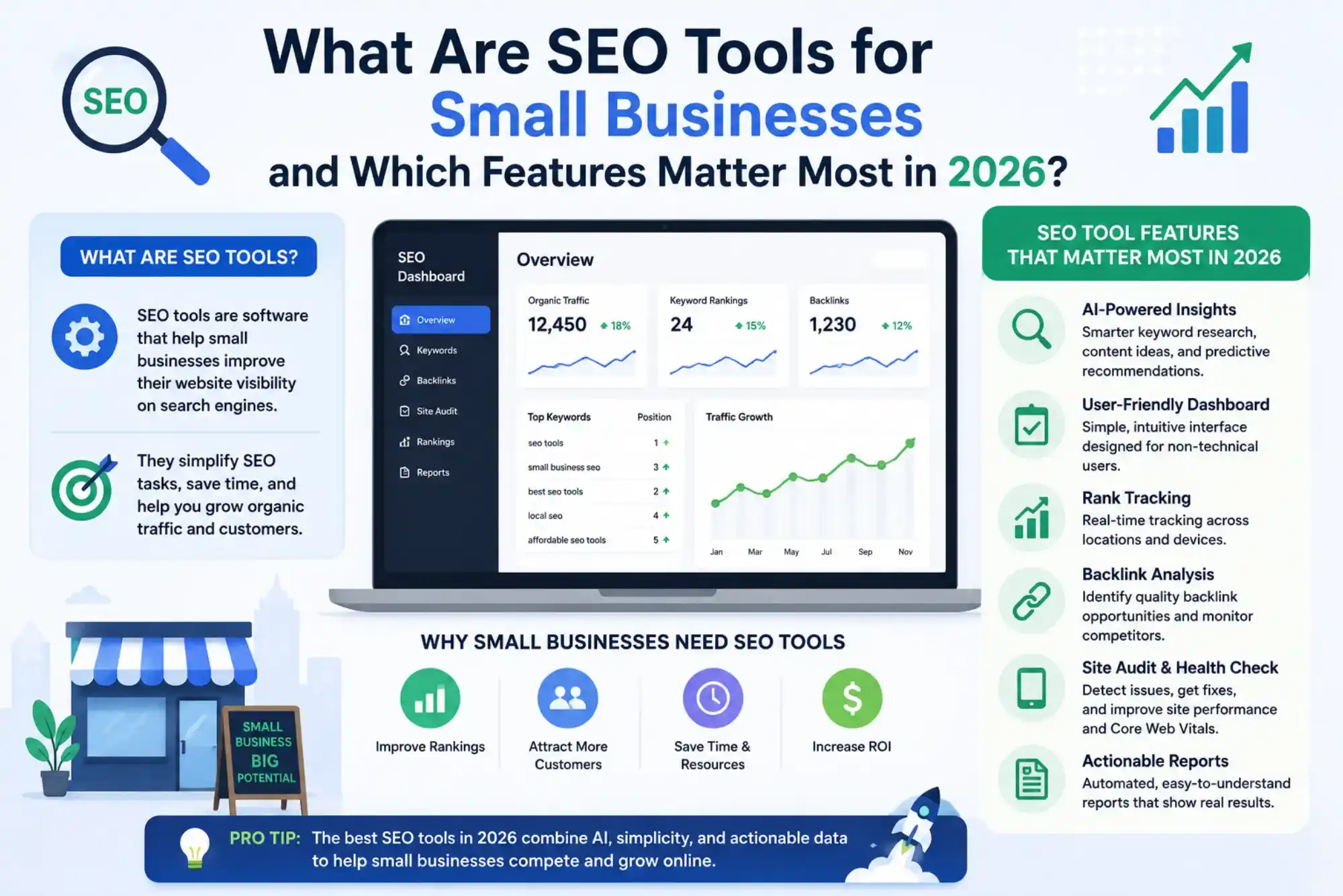
SEO tools for small businesses are software platforms that help business owners and marketers improve their website’s visibility in organic search results. They do this by providing data and functionality across several overlapping areas: understanding what potential customers are searching for, identifying technical problems that prevent the website from ranking well, monitoring how the site’s pages perform in search results over time, analysing what competitor websites are doing differently, and building the authority signals that search engines use to assess credibility.
At their core, SEO tools are data platforms. They take raw search engine data — which keywords generate traffic, which pages rank for which queries, which sites link to yours, how fast your pages load — and present it in a form that makes action possible. For a small business with limited marketing resources, the most valuable SEO tool is not necessarily the one with the most features but the one that surfaces the right information quickly enough to be acted on without requiring a specialist to interpret it.
The Main Categories of SEO Tool Features
Before evaluating specific platforms, it helps to understand the functional categories that SEO tools cover. Different tools prioritise different areas, and small businesses benefit from understanding which categories matter most for their specific situation before choosing a platform.
| Feature Category | What It Does | Who Needs It Most |
|---|---|---|
| Keyword Research | Identifies what search terms potential customers use and how competitive they are | All small businesses producing content or planning a web presence |
| Rank Tracking | Monitors where the website appears in search results for target keywords over time | Businesses with an established web presence wanting to measure progress |
| Technical SEO Audit | Crawls the website and identifies issues affecting indexing, speed, and crawlability | Any business that has had a website for more than six months |
| On-Page Optimisation | Analyses individual pages for keyword usage, meta tags, structure, and content quality | Businesses actively producing and publishing content |
| Backlink Analysis | Shows which websites link to yours and monitors link profile health | Businesses in competitive niches where authority building is necessary |
| Local SEO Tools | Manages citations, Google Business Profile performance, and local ranking data | Service businesses and retailers with physical locations |
| Competitor Analysis | Shows what keywords competitors rank for and where their traffic comes from | Businesses in competitive markets researching content and keyword gaps |
| Reporting and Dashboards | Presents performance data in clear, shareable formats | Business owners tracking ROI or reporting to partners and stakeholders |
Which Features Matter Most for Small Businesses in 2026
Not every feature category carries equal weight for every small business. The priorities depend on where the business is in its digital journey and what its most pressing visibility challenges are. That said, certain features consistently deliver disproportionate value for small businesses regardless of industry or stage.
Keyword Research: The Foundation of Any SEO Strategy
Keyword research is the single most important feature for a small business starting or rebuilding its SEO strategy. Understanding which terms your potential customers actually use when searching for your products or services — and how competitive those terms are — determines whether the content and pages you create have a realistic chance of ranking. Without this foundation, SEO investment is essentially guesswork.

For small businesses, the most valuable keyword research features are search volume data, keyword difficulty scores, and related keyword suggestions. Search volume tells you how many people are searching for a term each month. Keyword difficulty tells you how hard it would be to rank on the first page given your current domain authority. Related suggestions surface terms you may not have thought to target, particularly long-tail queries with lower competition that often convert better than high-volume generic terms.
Local keyword research is a specific sub-feature that matters enormously for service businesses and retailers. Understanding the search demand for terms like “accountant in Dubai” versus “Dubai accountant” versus “accounting services near me” — and which local variations have the highest volume and lowest competition — is directly actionable intelligence that generic keyword tools sometimes handle poorly. For businesses operating across UAE markets, understanding how the broader business landscape is structured — including how UAE businesses are categorised and found online — provides useful context for keyword strategy development.
Technical SEO Audit: Fixing What Prevents Rankings
A technically broken website cannot rank well regardless of how good the content is. Broken links waste crawl budget. Duplicate content confuses Google about which version of a page to index. Slow page load times increase bounce rates and directly affect Core Web Vitals scores. Missing meta tags reduce click-through rates even when a page appears in search results.
For small businesses, the most practical technical SEO audit features are those that identify issues clearly, prioritise them by impact, and explain how to fix them in plain language. A tool that surfaces fifty technical errors without indicating which three are causing the most damage to organic visibility is less useful than one that surfaces the top five issues with specific fix instructions. Automated weekly or monthly crawls that alert the business owner when new issues appear are significantly more practical than tools that require manual scheduling.
Rank Tracking: Measuring Progress Over Time
Rank tracking answers the fundamental question every small business owner asks about SEO: is it working? Monitoring where the website appears in search results for a defined set of target keywords over time provides the feedback loop that makes it possible to identify what is working and what needs adjustment. Without it, SEO becomes a faith-based exercise rather than a measurable business activity.
The most useful rank tracking features for small businesses are daily or weekly position updates, historical trend charts that show direction of travel over months rather than just current positions, and automated email digests that deliver a summary of significant movements without requiring manual log-ins. SERP feature tracking — showing whether the business appears in Local Pack results, Featured Snippets, or People Also Ask boxes in addition to standard organic positions — is increasingly important as these features capture a growing share of total search clicks.
Local SEO Features: Critical for Service Businesses
For small businesses with physical locations or defined service areas, local SEO features are among the highest-priority capabilities to look for in any platform. Local search visibility — appearing in Google Maps, the Local Pack, and local organic results — drives a significant proportion of phone calls, direction requests, and store visits for most service businesses and retailers.
Key local SEO features include Google Business Profile performance tracking, citation management across local directories, local rank tracking segmented by geographic area, and review monitoring. Tools that integrate these local-specific capabilities alongside standard keyword and technical SEO features save small businesses from needing to subscribe to separate specialist local SEO platforms alongside a general SEO tool. For small businesses navigating the operational aspects of running and growing a business digitally, understanding how software tools integrate with broader business management — including resources on how CRM platforms connect with digital operations — provides useful context for building an integrated approach to online visibility.
Recommended SEO Platforms for Small Businesses in 2026
With the feature priorities established, the following platforms represent the most practical options for small businesses in 2026 across different budget levels and use cases.
| Platform | Strongest Feature Area | Approximate Cost | Best For |
|---|---|---|---|
| Google Search Console | Real search performance data, indexing, Core Web Vitals | Free | All small businesses as a foundational tool |
| Semrush | Keyword research, rank tracking, competitor analysis, reporting | From approx. $140/month | Established businesses ready to invest in full-spectrum SEO |
| Moz Pro | Accessible interface, local SEO, weekly rank digests | From approx. $99/month | Small businesses managing SEO without a specialist |
| Ubersuggest | Keyword research, site audit, rank tracking at low cost | Low monthly or lifetime licence | Early-stage businesses or those with limited budgets |
| BrightLocal | Local SEO, citation management, Google Business Profile tracking | From approx. $39/month | Service businesses and retailers with physical locations |
| Ahrefs | Backlink analysis, keyword research, competitive intelligence | From approx. $129/month | Businesses in competitive niches prioritising authority building |
Features Small Businesses Should Avoid Over-Investing In
Just as important as knowing which features matter is understanding which features represent over-investment for small businesses that are still building their organic presence. Enterprise-level features — advanced API access, white-label reporting suites, multi-user workspaces with role-based permissions, and AI-assisted content generation at scale — add significant cost without delivering proportionate value for a business with a small website and a single person responsible for digital marketing.
Similarly, backlink analysis is a feature that many SEO tool providers market heavily but that delivers limited practical value for small businesses in the early stages. Understanding your backlink profile matters when you have a developed content strategy and are actively pursuing link-building opportunities. Before that point, the time investment required to interpret and act on backlink data is rarely justified compared to focusing on keyword research, content creation, and technical fixes that have more immediate impact on rankings.
The most common over-investment trap for small businesses is subscribing to the highest tier of a premium platform because it feels like a stronger commitment to SEO, when the entry-level tier of the same platform — or a lower-cost competitor — covers everything the business actually needs at its current stage. Starting at a lower tier and upgrading as the SEO strategy matures and the site grows is consistently more efficient than paying for capabilities that will not be used for another 12 months. For small businesses operating in dynamic markets and looking to understand how digital strategy intersects with broader business growth, exploring resources on digital marketing for growing businesses provides useful framing for prioritising tool investment at different stages of development.
How to Choose the Right SEO Tool for Your Small Business
The right SEO tool for a small business is determined by three factors: where the business is in its digital journey, what its most pressing visibility challenge is, and what budget is realistically available on an ongoing basis. A business launching a new website has different needs from one that has published content for two years and wants to understand why its traffic has plateaued.
For businesses at the earliest stage, Google Search Console plus a free trial period on a mid-tier platform like Semrush or Moz provides enough data to identify the most important opportunities without committing to subscription costs before seeing whether the tool fits the workflow. For businesses actively producing content and tracking keyword positions, a paid platform with automated rank tracking and weekly reporting is worth the investment because it surfaces information that changes editorial decisions and allocates effort more effectively.
For service businesses competing locally, a specialist local SEO platform like BrightLocal often delivers more practical value than a general SEO suite at a lower monthly cost. For the most authoritative guidance on how search engines evaluate website quality and relevance, consulting provides the foundational reference point that complements any tool’s recommendations.
Frequently Asked Questions
Do small businesses really need paid SEO tools?
Not immediately. Google Search Console provides free, accurate performance data that covers indexing, ranking queries, click-through rates, and Core Web Vitals. For businesses just starting out, this free tool combined with Google Trends and Google’s Rich Results Test covers the essential monitoring needs. Paid tools add value once the business is actively publishing content, tracking specific keywords, and competing for rankings — typically within six to twelve months of launching an SEO strategy.
What is the single most important SEO tool feature for a small business?
Keyword research is the highest-priority feature for most small businesses, particularly those in the early stages of building organic visibility. Understanding what your potential customers actually search for — and which terms are realistic ranking targets given your current authority — determines whether every subsequent content and optimisation decision is pointed in the right direction. Without this foundation, other SEO activities are significantly less efficient.
How much should a small business budget for SEO tools in 2026?
A practical starting budget for a small business investing in paid SEO tools is between $50 and $150 per month. This range covers the entry-level tiers of platforms like Moz Pro, Ubersuggest, and BrightLocal — all of which provide keyword research, rank tracking, and technical auditing adequate for most small business needs. Businesses in highly competitive niches or with more advanced content programmes may find value in mid-tier Semrush or Ahrefs subscriptions at $130 to $250 per month.
Can a small business manage SEO without a specialist using these tools?
Yes, with the right platform. Tools like Moz Pro and Semrush are specifically designed to surface actionable recommendations in plain language that do not require specialist interpretation. The key is choosing a tool that prioritises recommendations clearly rather than presenting raw data without context. Most small business owners who dedicate three to five hours per month to SEO — reviewing automated reports, updating content based on recommendations, and monitoring ranking trends — can manage a functional SEO programme without outsourcing the work.
SEO tools for small businesses are data platforms that make organic search visibility measurable, actionable, and improvable without requiring specialist expertise. The features that matter most — keyword research, rank tracking, technical auditing, and for service businesses, local SEO capabilities — are available at price points that fit small business budgets, particularly with the free foundation provided by Google Search Console. Choosing the right tool means matching the platform’s strengths to the business’s most pressing visibility challenge at its current stage, starting with what is needed now rather than paying for capabilities that will only become relevant later. Used consistently within a structured monthly workflow, the right SEO tool gives any small business a clear, evidence-based path to growing its organic presence in 2026 and beyond.
Related Reading: Is the Huawei Mate 80 Pro Worth It in 2026? Full Specs, Features & Huawei Mate 80 Price Guide — full guide
Related Reading: Trending Sweepstakes Slots & Features Players Love (2026) — full guide